Legal Basement Apartment Requirements in Durham, Ontario: Complete 2026 Checklist
Quick Answer: A legal basement apartment in Durham Region must meet Ontario Building Code requirements for ceiling height (min. 6'5"), egress windows, fire separation, interconnected smoke/CO alarms, and independent heating and ventilation. Each Durham municipality, Whitby, Oshawa, Ajax, Pickering, and Clarington, also has its own zoning bylaws and parking requirements. A building permit is mandatory. Without it, your unit is illegal, and your insurance is void.
What Makes a Basement Apartment "Legal" in Durham?
A lot of Durham homeowners have finished basements with a bedroom, a bathroom, and a kitchenette. But "finished" and "legal" are two very different things.
A legal basement apartment, also called a secondary suite or additional residential unit (ARU), is a self-contained dwelling unit that meets four distinct requirements:
Ontario Building Code (OBC) compliance, structural safety, ceiling height, fire separation, windows, ventilation
Local zoning bylaw approval, your property is in a zone that permits a second unit
Fire and Electrical Safety Authority (ESA) compliance, permits, inspections, and sign-offs for all electrical work
Municipal registration: the unit must be registered with your local municipality before it can be legally rented
Miss any one of these four boxes and your suit is not legal. It doesn't matter how nice the finishes are.
The 2024 Ontario Building Code update, with mandatory compliance now in effect as of 2025, introduced some changes that actually make it easier to build a legal suite in existing homes. Lower fire separation requirements for homes over five years old, wireless smoke alarm interconnection, and a lowered minimum ceiling height are all now in effect.
But the rules are still specific. And inspectors check every one of them.
The Complete 2026 Legal Basement Checklist
Use this as your go/no-go checklist before starting any legal basement project in Durham Region
| # | Requirement | Ontario Standard | Durham-Specific Notes |
|---|---|---|---|
| 1 | Ceiling height | Min. 1.95m (6'5") throughout | Measured after the finished floor and ceiling are installed |
| 2 | Egress window (per bedroom) | Min. 0.35m² clear opening, no dimension under 380mm | Casement style recommended; window well required if below grade |
| 3 | Fire separation, walls & ceiling | 30-min fire-resistance rating | Homes over 5 yrs: 15.9mm Type X drywall may qualify under Art. 9.10.9.16 |
| 4 | Fire-rated doors between units | 45-min solid core rated door | Self-closing hardware required |
| 5 | Interconnected smoke alarms | Every floor + every bedroom | Wireless interconnection is now permitted under the 2024 OBC |
| 6 | Carbon monoxide alarms | Near sleeping areas, if fuel-burning appliances are present | Required in all Durham Region municipalities |
| 7 | Independent or compliant heating | Separate system or fire dampers on shared ducts | Electric baseboard or ductless split most common solution |
| 8 | Ventilation & natural light | Must meet OBC habitable space standards | Bedrooms and living areas need a natural light source |
| 9 | Soundproofing (STC rating) | Min. STC 50 between units | OBC Part 9 Section 9 Clause 11.2 |
| 10 | Separate entrance | Required for rental units | Cannot require going through the main unit |
| 11 | Parking | 1 space per unit is typically required | Varies by municipality; check the local bylaw |
| 12 | Building permit | Mandatory | Obtained from the local municipality before construction |
| 13 | Electrical permit (ESA) | Mandatory for all electrical work | ESA inspects separately from the building permit |
| 14 | Suite registration | Required to legally rent | Each Durham municipality has its own process |
Requirement 1: Ceiling Height
The Ontario Building Code sets the minimum ceiling height at 1.95 metres (6 feet 5 inches) throughout all living areas. This includes hallways, bedrooms, the kitchen, and any route to the exit.
This measurement is taken after your finished floor and ceiling are installed. Not before.
That matters a lot. A basement with a raw concrete ceiling at 7 feet can easily fall below the 1.95m minimum once you add:
A raised subfloor (50–75mm)
Framing and drywall on the ceiling (75–100mm)
Plumbing drop-ceilings or bulkheads
Always confirm your clearance with a tape measure at the tightest point before any design work begins.
If your ceiling is too low, you have two options. Basement underpinning lowers the floor by excavating beneath the foundation. It's the more expensive route, typically $40,000–$95,000, but it gives you full ceiling height throughout. Bench-footing is a partial underpinning option that creates a stepped ledge around the perimeter and can cost less while gaining height in the centre of the space.
Most Durham Region homes built after 1985 have basement ceilings between 7'6" and 8' unfinished. These typically clear the requirement with room to spare. Pre-1985 homes often run 6'8" to 7'2", borderline, but usually workable without underpinning.
Requirement 2: Egress Windows

Every bedroom in a legal basement apartment needs a qualifying egress window. This is a non-negotiable life-safety requirement.
The Ontario Building Code requires:
Minimum clear opening area: 0.35m² (approximately 3.77 sq ft)
Minimum clear opening height: 380mm (approx. 15 inches)
Minimum clear opening width: 380mm (approx. 15 inches)
Must open without tools or keys from the inside
The critical word here is clear opening. This is not the window frame size. It is not the glass size. It is the actual unobstructed opening after the window is fully cranked or slid open.
Casement windows, hinged on one side, swinging fully outward, are the most reliable choice for meeting egress requirements. Sliding windows need larger frames to achieve the same clear opening.
If your basement window sits below grade, a window well is required. The well must be large enough for a person to stand in. If it is deeper than 600mm (24 inches), it needs a permanently attached ladder or steps.
Do not assume a "big" window will pass. Always get the clear opening dimensions from the manufacturer in writing before purchasing.
Requirement 3: Fire Separation
Fire separation is the requirement that inspectors check most carefully. It is also where most failed projects fall short.
The assembly between the basement suite and the main dwelling, including all walls and the floor/ceiling, must provide a fire-resistance rating. For most Durham Region homes, the requirement is a 30-minute fire-resistance rating.
There are two common ways to achieve this:
Option A, Standard Construction (New or Renovated):
One layer of 15.9mm (5/8") Type X drywall on walls and ceiling
This achieves a 30-minute rating
Option B, Retrofit Exemption for Homes Over 5 Years (Article 9.10.9.16):
A continuous smoke-tight barrier using 15.9mm Type X drywall may qualify
This was updated in the 2024 OBC and can significantly reduce renovation costs
Ask your building department if your project qualifies
All doors between units must be solid core and 45-minute fire-rated. They must have self-closing hardware. This applies to both the party wall door and the furnace/utility room door if it connects to the suite.
Any shared HVAC ductwork between units requires fire dampers at each penetration through the fire separation. Most contractors instead opt for a completely separate heating system for the basement unit to avoid this complexity.

Requirement 4: Smoke & Carbon Monoxide Alarms
The rules here are straightforward. Non-compliance is a serious liability.
Smoke alarms are required:
On every storey of both dwelling units
In every bedroom and outside every sleeping area
Interconnected between units, if one triggers in the basement, alarms sound in the main unit too
The 2024 OBC now permits wireless interconnection. This eliminates the need to run new wiring between floors in existing homes. It's a meaningful cost saving for retrofit projects.
Carbon monoxide alarms are required:
Near sleeping areas in any unit that has a fuel-burning appliance (furnace, water heater, gas stove)
Near sleeping areas in any unit with access to an attached garage
All alarms must be listed to the appropriate Canadian Standards Association (CSA) standard.
Requirement 5: Heating, Ventilation & Natural Light
Every room in the basement suite must be adequately heated. The two most common approaches in Durham Region:
Option A, Extend Existing Forced-Air System: You can extend your home's existing HVAC into the basement suite, but fire dampers are required at every duct penetration through the fire separation. The system must also be capable of maintaining the space at a minimum of 18°C (updated from 22°C in the 2024 OBC).
Option B, Independent System for Basement (Recommended): A ductless mini-split or electric baseboard system for the basement unit is the cleanest solution. It eliminates the fire damper complexity, gives your tenant independent temperature control, and makes utility metering simpler. Most legal basement contractors in Durham recommend this approach.
Natural Light: Every bedroom and habitable room must have natural light. This is typically met by the same windows that serve egress. Living areas without windows may not qualify as bedrooms.
Requirement 6: Soundproofing
The Ontario Building Code requires a minimum Sound Transmission Class (STC) rating of 50 between units. This applies to both the party wall and the floor/ceiling assembly.
STC 50 is the legal minimum. It is not, however, the quality-of-life minimum. At STC 50, you can still hear loud speech and footsteps through the ceiling.
For a better result, and a much better landlord-tenant relationship, go beyond code:
Resilient channels on the ceiling are decoupled from the floor joists above
Acoustic mineral wool insulation (Rockwool Safe-N-Sound) in all cavities
Double layer of drywall on the ceiling with staggered joints
This adds $3,000–$6,000 to the project but is one of the highest-value upgrades you can make. Noise complaints are the most common reason for tenant disputes.
Requirement 7: Separate Entrance & Parking
Separate Entrance: A legal basement apartment in Durham Region must have its own entrance. Tenants cannot be required to enter through the main dwelling unit.
This entrance can be at the front, side, or rear of the home. Most Durham homes use a side door or rear walkout. Exterior work, including new door openings, framing, weatherproofing, and steps, is a standard part of any legal basement build.
Parking: Durham Region municipalities require a minimum of one parking space per dwelling unit. For a two-unit home, that means a minimum of two spaces.
In most cases, a double-wide driveway meets this requirement. But some municipalities also require the parking to meet specific dimensions and accessibility standards.
Requirement 8: Permits & Inspections
A building permit is mandatory for every legal basement apartment in Ontario. Working without one is not a shortcut. It is a liability. See the full basement finishing process and what to expect.
The permit process for a legal basement suite in Durham Region typically covers:
Building permit (framing, fire separation, structural)
Electrical permit through the ESA (separate from building permit)
Plumbing permit (if adding or modifying bathroom or kitchen plumbing)
Timeline: Permit approval in Durham Region typically takes 3–5 weeks for straightforward applications. Complex projects or those requiring zoning variances can take 8–12 weeks.
Plan for this. Do not start construction before permits are approved.
After construction, inspections are required at multiple stages: framing, insulation, fire separation, and final. All must be signed off before the unit can be occupied or rented.
Urban RenoProjects handles the entire permit process as part of every legal basement project. We prepare drawings, submit applications, and manage all inspections on your behalf.
Durham Municipality Rules: What Changes By Town
The Ontario Building Code is province-wide. But zoning bylaws and permit processes are municipal. Here is what changes depending on where you are in Durham Region:
| Municipality | Permit Office | Key Local Notes |
|---|---|---|
| Town of Whitby | whitby.ca, Building Department | Second units allowed in most residential zones; parking must be on-site |
| City of Oshawa | oshawa.ca, Building Services | Minimum 11m lot frontage; specific parking configuration rules |
| Town of Ajax | ajax.ca, Building Services | Second units permitted in most detached and semi-detached homes; zoning confirmation recommended before permit submission |
| Municipality of Clarington | clarington.net, Building Division | ARU policy supports second suites; rural properties may have additional restrictions |
| City of Pickering | pickering.ca, Building Services | Second units are supported in most residential zones; review the zoning bylaw before proceeding |
The most important step before starting any legal basement project: confirm your zoning allows a second unit with your specific municipality. This takes one phone call or a quick online lookup. Do it before spending money on drawings.
Durham Region's Official Plan supports additional residential units as part of its housing affordability strategy. The planning environment is favourable. But each town applies it differently.
How Much Does a Legal Basement Apartment Cost in Durham?
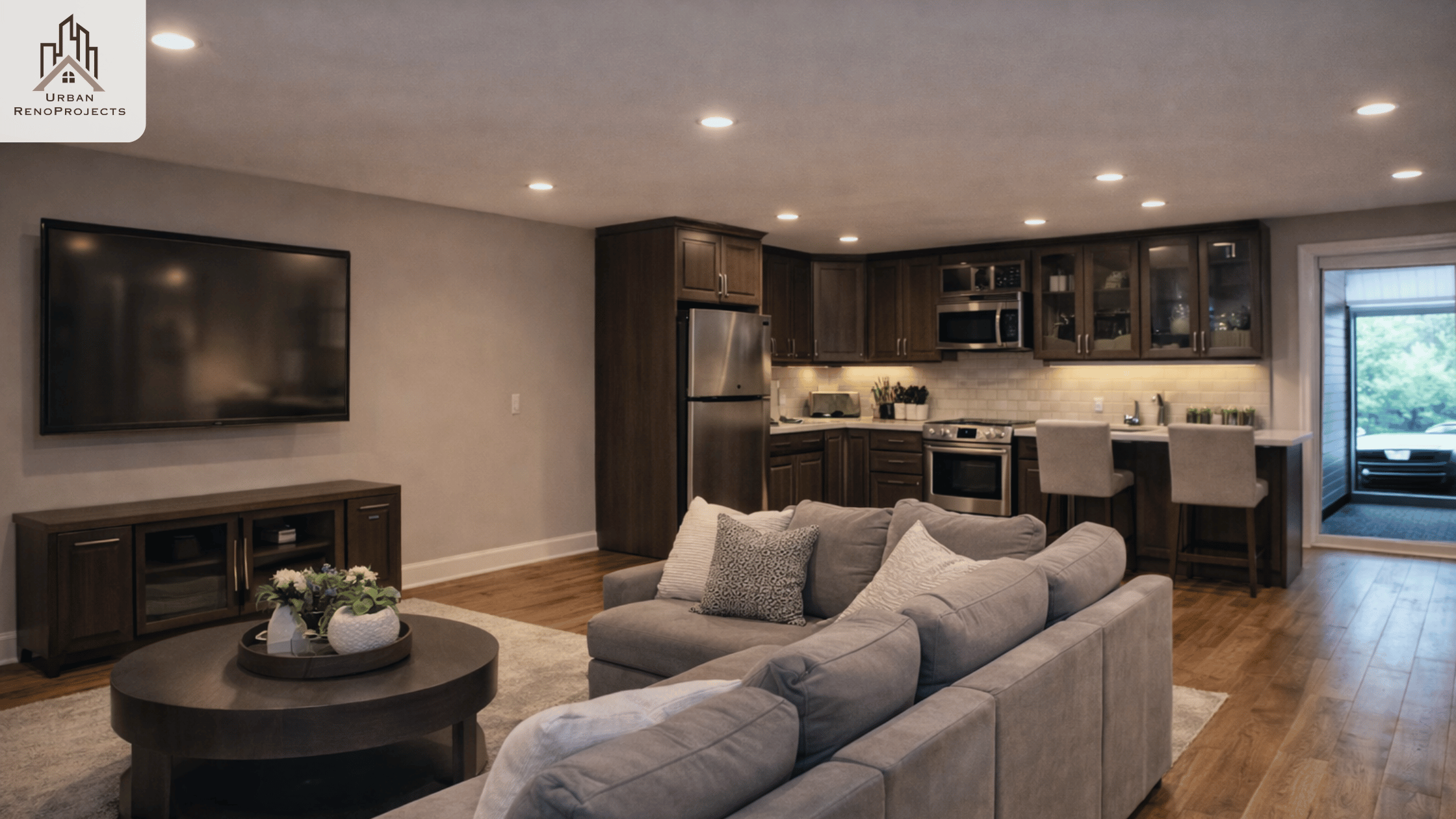
A full legal secondary suite in Durham Region typically costs $85,000–$140,000+.
Here is what drives that number:
| Component | Cost Range |
|---|---|
| Framing, drywall & fire separation | $8,000–$14,000 |
| Electrical (permit + ESA inspection) | $6,000–$12,000 |
| Plumbing (bathroom + kitchen rough-in) | $12,000–$22,000 |
| Egress windows (per window installed) | $2,500–$4,500 |
| Separate entrance (door, framing, exterior work) | $3,500–$8,000 |
| Independent HVAC (ductless mini-split) | $4,000–$8,000 |
| Soundproofing upgrade | $3,000–$6,000 |
| Flooring, finishing, kitchen, bathroom fixtures | $20,000–$40,000 |
| Permits & drawings | $2,500–$5,000 |
| Total (excl. underpinning) | $85,000–$140,000 |
If your basement needs underpinning to reach the minimum ceiling height, add $40,000–$95,000 to that figure.
For more details on basement renovation pricing in Durham, read our complete 2026 basement renovation cost guide.
Is it worth it?
In Durham Region, a legal basement apartment generates approximately $1,500–$2,200 per month in rental income. At $1,800/month, a $110,000 investment pays for itself in just over 5 years, and continues earning indefinitely after that.
If you're evaluating the full investment, learn more about full home renovation costs in Durham Region before planning your project.
Why Illegal Suites Are Not Worth the Risk
Many Durham homeowners rent out basement units that were never properly permitted. This is understandable, the reno was cheaper, the process was faster. But the risks are serious.
Insurance voidance. Most home insurance policies require all dwelling units to be code-compliant and legally registered. An illegal suite can void your entire home insurance policy, not just coverage for the basement.
Fines and orders. Municipalities across Durham Region actively investigate unpermitted units. A stop-work order or a requirement to demolish non-compliant work is a real outcome.
Resale problems. A buyer's home inspector will flag an unpermitted basement suite. It can kill your sale or reduce your selling price by more than the cost of doing it properly.
Liability exposure. If a tenant is injured or a fire starts in an illegal suite, your liability as an unpermitted landlord is significant.
The cost of doing it right is higher upfront. The cost of doing it wrong is much higher when it catches up with you.
How Urban RenoProjects Handles Legal Basement Builds in Durham

We have built legal basement apartments across Whitby, Oshawa, Ajax, Pickering, and Clarington. Here is exactly what we do on every project.
Step 1: Free Site Assessment. We visit your home, check ceiling height, assess existing conditions, and confirm your zoning allows a second unit. No cost, no pressure.
Step 2: Fixed-Price Quote: You receive an itemized, written quote with a fixed price. Every component, permits, trades, trade, is included. No surprises after you sign.
Step 3: Drawings & Permit Submission: We prepare all required architectural drawings and submit your permit application to your local Durham municipality. We track approval and handle any building department questions.
Step 4: Construction. Our team manages every trade in sequence, framing, fire separation, electrical, plumbing, insulation, HVAC, windows, flooring, kitchen, and bathroom. You get regular progress updates throughout.
Step 5: Inspections & ESA Sign-Off: We schedule and manage every inspection, framing, insulation, fire separation, electrical, and final. Every stage is signed off on before we close it in.
Step 6: Handover + Registration Support: We do a final walkthrough with you. We can also guide you through the municipal registration process for your new secondary suite.
Your legal basement apartment is backed by our 1-year workmanship warranty and built to be fully compliant with the 2026 Ontario Building Code.
Frequently Asked Questions
Does my property qualify for a legal basement apartment in Durham Region?
Most detached and semi-detached homes in Durham Region qualify, provided your lot is zoned for residential use with secondary units. The quickest way to confirm is to call your local municipality's planning department or search your address in their online zoning map. Urban RenoProjects confirms zoning eligibility during our free site assessment.
How long does it take to build a legal basement apartment in Durham?
From first contact to a move-in-ready suite, expect 4–7 months total. This includes 2–4 weeks for design and drawings, 3–5 weeks for permit approval, and 10–16 weeks for construction and inspections. Projects requiring underpinning take longer.
Can I use my existing furnace to heat the basement apartment?
Yes, but it requires fire dampers at every duct penetration through the fire-rated floor/ceiling assembly. Most Durham contractors recommend a separate ductless mini-split system for the basement unit instead; it's cleaner, code-compliant, and gives your tenant independent temperature control.
What is the minimum bedroom size for a legal basement apartment in Ontario?
The Ontario Building Code requires a minimum bedroom floor area of 7 square metres (approximately 75 sq ft) with no dimension less than 2 metres. Every bedroom must also have a qualifying egress window.
Do I need to register my basement apartment with the Town of Whitby or the City of Oshawa?
Yes. Every Durham Region municipality requires registration of secondary suites before they can be legally rented. Registration typically requires a final inspection, proof of permits, and confirmation of compliance. Urban RenoProjects guides registration as part of our handover process.
Will an illegal basement suite affect my home insurance?
Yes. Most home insurance policies require all dwelling units to be code-compliant. An unpermitted basement suite can void coverage on your entire property, including the main dwelling. Always confirm with your insurance provider before renting any basement unit.
Ready to Build Your Legal Basement Apartment in Durham?
Getting the requirements right from the start is what separates a smooth project from an expensive nightmare.
Urban RenoProjects specializes in legal basement apartments across Whitby, Oshawa, Ajax, Pickering, and Clarington. We handle permits, inspections, and every trade, so you end up with a fully compliant, rental-ready suite.
Book Your Free Site Assessment →
Or call us directly at (416) 879-8379