Basement Kitchen & Wet Bar: Adding a Second Kitchen to Your Durham Home

Basement kitchen renovation in Durham Region legal suite kitchen by Urban RenoProjects | Urban Renoprojects
Adding a basement kitchen or wet bar in Durham Region costs between $15,000 and $85,000+ depending on what you're building. A wet bar or basic kitchenette runs $15,000-$35,000. A full legal basement kitchen for a secondary suite runs $35,000-$85,000+. The critical decision isn't how much to spend - it's whether you're building for personal use or rental income, because the answer determines everything: the code requirements, the permits, and the ROI.
Why Durham Homeowners Are Adding Basement Kitchens
The basement kitchen is the renovation that keeps paying.
For Durham Region homeowners, it unlocks one of three things - sometimes all three at once:
Rental income. A legal basement suite with a full kitchen generates $1,500-$2,200 per month in Durham Region. That's $18,000-$26,400 per year. At that rate, a $100,000 legal suite renovation pays for itself in under 5 years and generates income indefinitely after that.
Multi-generational living. In-laws who want independence without moving out. Adult children who need space but not a mortgage. A basement kitchen makes that arrangement livable - for everyone.
Entertainment space. A wet bar or kitchenette in a finished basement transforms it from a TV room into a genuine hosting space. Movie nights, sports watching, extended family gatherings - all without the constant trips up and down the stairs.
Adding a kitchenette or wet bar costs $5,000-$30,000+. Building a legal basement suite costs $60,000-$120,000+. The gap between those numbers reflects the gap between a convenience feature and a legal income-generating asset - and understanding which you're building is the most important decision you'll make before any work starts. Many homeowners exploring basement renovation services in Durham start with either a wet bar or a full legal kitchen.
Wet Bar vs. Kitchenette vs. Full Kitchen: What's the Difference?
These three terms get used interchangeably in renovation conversations. They are not the same thing - and the differences have real implications for cost, permits, and what you can legally do with the space.
Wet Bar
A wet bar has a sink with plumbing, a small refrigerator, a countertop for drink preparation, and typically cabinetry for storage. It does not have a stove, cooktop, or oven.
Best for: Entertainment-focused finished basements where the primary use is hosting. Does not qualify a space as a secondary suite. Generally lower permitting requirements than a full kitchen.
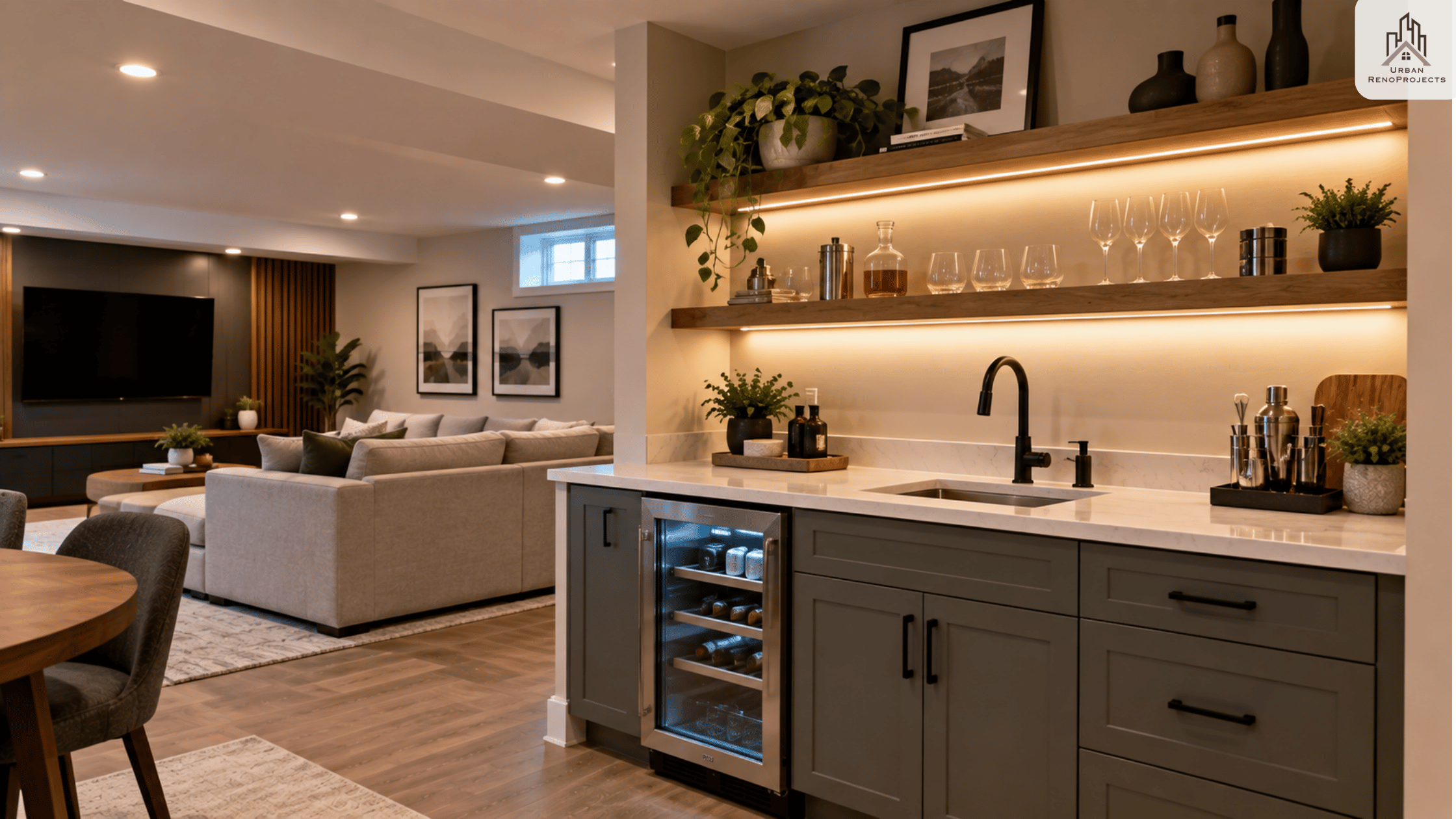
Basement wet bar with sink and bar refrigerator in Whitby Ontario | Urban RenoProjects
Code note: A wet bar with a sink still requires a plumbing permit in Durham Region. The sink must drain to the existing drain system. The refrigerator circuit requires proper electrical work.
Kitchenette
A kitchenette adds a cooking appliance - typically a compact range, a cooktop, or a microwave/convection combination - to the wet bar setup. It may or may not have a full-size refrigerator.
Best for: In-law suites, occasional hosting spaces, or basement areas used by family members who want some cooking capability without full independence.
A basement kitchenette without a separate entrance, not functioning as an independent dwelling unit, is not a secondary suite and doesn't require ARU registration. However, if it includes a cooking appliance such as a stove or cooktop, it must meet OBC ventilation requirements - 120 cfm hood vented to exterior - and OBC electrical requirements including a 20-amp small-appliance circuit and GFCI outlets.
Full Legal Kitchen
A Full compliance with legal basement apartment requirements - required for a registered secondary suite - has a full-size range or cooktop with oven, a full-size refrigerator, cabinetry, a sink with plumbing, and a range hood vented to the exterior.
Best for: Legal basement apartments that will be rented to a tenant. The kitchen is the centrepiece of the suite and must meet OBC secondary suite requirements to allow legal occupancy and registration.
This option unlocks rental income. It also triggers the full suite of secondary suite requirements - fire separation, egress windows, separate entrance, smoke alarms, ESA electrical permit, and municipal registration.
Cost Breakdown: Wet Bar, Kitchenette & Full Legal Kitchen
| Type | What's Included | Cost Range (Durham Region, 2026) |
|---|---|---|
| Wet Bar | Sink, refrigerator, cabinetry, countertop, plumbing rough-in | $12,000-$22,000 |
| Kitchenette | Compact range or cooktop, sink, refrigerator, cabinetry, countertop, vented range hood, plumbing + electrical | $20,000-$40,000 |
| Full Legal Kitchen | Full range, full refrigerator, sink, cabinetry, countertop, vented range hood, all plumbing + electrical to OBC standard | $35,000-$65,000 |
| Full Legal Suite (kitchen + bathroom + suite requirements) | Everything above plus fire separation, egress windows, separate entrance, HVAC, all permits | $85,000-$140,000+ |
If the basement has existing plumbing rough-ins, kitchen costs land toward the lower end. If concrete cutting is required to run new drain lines, add $4,000-$10,000.
What Drives the Cost Up
Concrete cutting. If your basement doesn't have existing plumbing rough-ins near the kitchen location, new drain lines need to go somewhere - and below-slab drains mean cutting concrete. This is the single biggest swing factor in basement kitchen cost.
Venting. A range hood must vent to the exterior - not recirculate, not vent into the joist cavity, not vent into a soffit. Running the duct to an exterior wall is straightforward in most Durham Region homes. Running it across the basement ceiling to the other side of the house is not. Duct routing significantly affects cost.

Range hood exterior venting installation during basement kitchen renovation in Durham Region | Urban Renoprojects
Cabinetry quality. Kitchen cabinetry ranges from $3,000 for basic stock units to $20,000+ for custom millwork. For a rental suite, mid-range semi-custom is the right balance - durable enough to last with tenants, attractive enough to command good rent.
Appliances. For a rental suite, mid-range appliances ($3,000-$6,000 for the set) hit the right balance of durability and appeal. For a personal entertainment space, appliance selection is more about preference than code.
What the Ontario Building Code Requires for Each Type
Understanding the code requirements before you design saves significant money and avoids surprises during inspection.
For a Wet Bar (No Cooking Appliance)
Plumbing permit required for new sink drain and supply connections
GFCI electrical outlets near the sink
ESA electrical permit if new circuits are being added
No range hood or ventilation requirement
For a Kitchenette (With Cooking Appliance)
Plumbing permit for sink connections
ESA electrical permit - 20-amp small appliance circuit required
Range hood vented to exterior - minimum 120 cfm
GFCI outlets within 1.2m of the sink
Building permit required if structural work is involved
For a Full Legal Kitchen (Secondary Suite)
All of the above, plus:
Full compliance with OBC secondary suite requirements (fire separation, egress, alarms)
Separate 200-amp electrical panel or dedicated sub-panel for the suite
All work inspected by ESA before any electrical is covered
Building permit from your Durham Region municipality required before any work starts
Municipal registration of the suite required before it can be legally rented
The difference between a profitable rental unit and a liability trap often comes down to one room: the kitchen. Navigating the legal basement kitchen requirements is critical because this area is the focal point for building inspectors, the Electrical Safety Authority, and fire marshals.
Urban RenoProjects manages all permit applications, ESA coordination, and inspection scheduling for every basement kitchen project in Durham Region.
The Rental Income Case: Legal Basement Kitchen ROI in Durham
The financial case for a legal basement suite in Durham Region is compelling - and the kitchen is what makes it legal.
Durham Region rental income data (2026):
1-bedroom legal suite: $1,500-$1,900/month
2-bedroom legal suite: $1,900-$2,400/month
Average: approximately $1,800/month
At $1,800/month, a $110,000 legal suite renovation - including the full kitchen - generates $21,600 per year in rental income. Simple payback: just over 5 years. After payback, the rental income continues. The resale value contribution (typically $60,000-$100,000+ added to home value for a legal suite in Durham Region) is on top of that.
Combined with rental rates above $1,800 in the GTA and multi-generational living pressure, a legal suite has gone from "nice to have" to one of the highest-ROI renovations a homeowner can make.
Durham Region's rental vacancy rate is consistently low. GTA workers priced out of Toronto, Oshawa's expanding healthcare and education employment base, and limited rental supply across Whitby, Ajax, and Pickering all support strong demand for well-maintained legal suites.
The kitchen is not an add-on to a legal suite. It is what makes the suite legal - and what makes the investment pay. If you're planning how to add a legal basement suite, understanding the kitchen requirements is critical.
Design Ideas: What Works Best in Durham Region Basements
For Wet Bars and Entertainment Spaces
The beverage centre layout - a compact sink, wine fridge, bar refrigerator, and countertop for entertaining - works well in open-concept finished basements. Keep it against a perimeter wall to minimise plumbing runs. A floating shelf above the counter and under-cabinet lighting make a strong visual impact without premium cabinetry costs.
Built-in storage around the wet bar doubles as display space for glassware and bottles. Full-height cabinetry on either side of the bar area creates a cohesive look that feels intentional rather than added-on.
For Legal Suite Kitchens
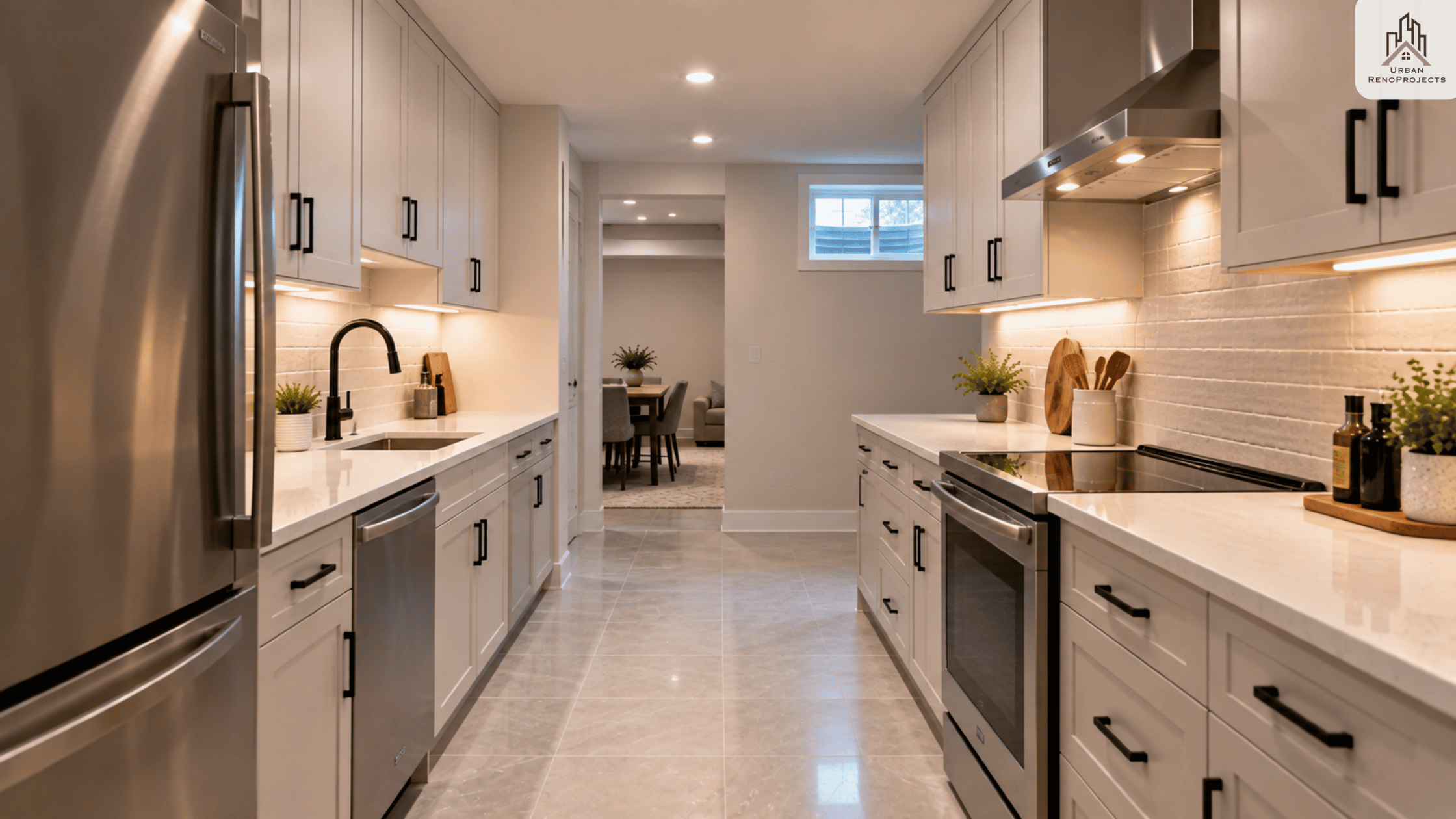
Legal basement suite kitchen in Durham Region galley layout with porcelain tile floor | Urban Renoprojects
The galley layout is the most efficient for a basement kitchen. Two runs of cabinetry facing each other make the most of a typically narrow basement kitchen space. Upper cabinets on one side, open shelving on the other, creates a feeling of space without sacrificing storage.
Light cabinetry with quartz countertops is the combination that photographs best and appeals to the broadest range of tenants. Avoid dark cabinetry in below-grade kitchens - basements already have limited natural light.
Large-format porcelain floor tile - 24x24 or 12x24 - reads larger than small tile, makes the kitchen feel bigger, and is easy to clean. Grout lines are minimal with large format tile, which matters in a rental context.
Under-cabinet lighting in a rental suite costs $400-$800 and dramatically improves the perceived quality of the kitchen. It is one of the highest-return lighting investments in any basement renovation cost in Durham.
What Durham Homeowners Need to Know Before Starting
Plumbing Rough-Ins - Check First
Before designing any basement kitchen in Durham Region, confirm what plumbing rough-ins exist in your basement. Many Durham homes built between 1985 and 2005 have basement bathroom rough-ins - a capped drain in the floor ready for a future bathroom. A kitchen drain nearby makes the project significantly less expensive.
If no rough-ins exist near your planned kitchen location, concrete cutting is required to run new drain lines. This adds $4,000-$10,000 and a few days of additional work. It is not a barrier - but it is a budget line that surprises homeowners who didn't check first.

Concrete cutting for basement kitchen drain lines in Oshawa Ontario | Urban Renoprojects
Durham Region Permit Requirements
Both a building permit and an ESA electrical permit are required for any basement kitchen involving a cooking appliance. Urban RenoProjects handles both across all Durham Region municipalities - Whitby, Oshawa, Ajax, Pickering, and Clarington.
For a full legal suite, additional requirements apply including zoning confirmation, fire separation review, and municipal registration after final inspection. We manage the entire process.
Bill 23 and As-of-Right Zoning
Bill 23, the More Homes Built Faster Act, forced every Ontario municipality to permit additional residential units as-of-right, which means homeowners can add a second unit without rezoning. This applies across Durham Region - most detached and semi-detached homes now qualify for a legal secondary suite without a zoning variance. Confirm with your local municipality, but the planning environment in Durham Region is favourable for basement suite development.
How Urban RenoProjects Builds Basement Kitchens in Durham
Whether you're adding a wet bar for entertaining or building a full legal kitchen for a rental suite, Urban RenoProjects delivers the complete scope under one fixed-price contract.
Every basement kitchen project includes:
Free site assessment - we check existing plumbing rough-ins, drain locations, and duct routing before quoting
Fixed-price written quote - wet bar, kitchenette, or full legal kitchen, all costs locked in before you sign
All permit applications managed - building permit and ESA electrical permit across all Durham Region municipalities
Plumbing, electrical, cabinetry, countertop, appliances, and range hood installation - all trades coordinated
For legal suites: fire separation, egress windows, separate entrance, and all OBC compliance managed as part of the project
1-year workmanship warranty on all completed work
See our completed basement kitchen and suite projects →
Get a free basement kitchen quote →
Frequently Asked Questions
Do I need a permit to add a wet bar in my Durham Region basement?
A plumbing permit is required for the new sink drain and supply connections. An ESA electrical permit is required if new circuits are being added. A building permit is required if structural work is involved. Urban RenoProjects handles all permit applications as part of every project.
What is the difference between a kitchenette and a legal basement kitchen in Ontario?
A kitchenette has a cooking appliance and meets basic OBC requirements for ventilation and electrical. A legal basement kitchen is part of a fully compliant secondary suite - with fire separation, egress windows, separate entrance, and municipal registration - that can be legally rented to a tenant. The legal kitchen triggers the full suite of secondary suite requirements.
Can I add a kitchen to my basement without making it a rental suite in Durham Region?
Yes. A kitchenette in a basement that is used by the homeowner and their family - not rented to a separate tenant - does not require secondary suite registration. It does still require building and electrical permits, and must meet OBC kitchen ventilation and electrical requirements. If you later decide to rent the space, it would need to be upgraded to full secondary suite standards.
How much does it cost to add a wet bar to a finished basement in Whitby?
A wet bar in a finished Whitby basement - sink, refrigerator, cabinetry, countertop, and plumbing - typically costs $12,000-$22,000. The main variable is whether existing plumbing rough-ins are accessible near the planned location. If concrete cutting is required, add $4,000-$8,000.
Does Urban RenoProjects build legal basement kitchens and suites in Oshawa and Ajax?
Yes. Urban RenoProjects builds basement kitchens, wet bars, kitchenettes, and full legal secondary suites across Whitby, Oshawa, Ajax, Pickering, and Clarington. All projects include full permit management and OBC compliance.
See more FAQs - Frequently Asked Questions.
Ready to Add a Kitchen to Your Durham Basement?
A basement kitchen is one of the highest-return additions a Durham Region homeowner can make - whether it generates rental income, supports multi-generational living, or simply transforms how you use your home every day.
Urban RenoProjects builds basement kitchens across Durham Region with fixed-price contracts, full permit management, and a 1-year workmanship warranty.

Basement kitchenette with compact range and cabinetry in Ajax Ontario | Urban RenoProjects
Written by the Urban RenoProjects Team. Licensed & Insured Renovation Contractor serving Durham Region, Whitby, and the GTA. WSIB Certified. Ontario Building Code compliant.